Biology's bitter lesson
PROGRESS TOWARDS programmable medicine will ultimately be driven by large, general models computing over vast quantities of novel biological information, not by the specialist models and expert heuristics that have defined the field so far.Just as language models learn from the internet, Basecamp’s EDEN models learn from BaseData, the largest, fastest-growing and most information-rich biological dataset ever built. That foundation gives EDEN an incredible understanding of how life works, and makes it the first model able to translate directly from disease biology to therapeutic candidates. EDEN works across a wide range of modalities and diseases, and works zero-shot in living systems.To mark the release of the BioNeMo Agent Toolkit, NVIDIA’s open platform that turns any AI agent into an autonomous life sciences scientist, we show how frontier biological models and frontier agentic capabilities, together, open a path to a world where programmable medicine is accessible to all.
The path to designing medicine with machines
The Bitter Lesson is one of the hardest won lessons in AI. Wherever there has been a breakout success, the winning approach has not been the one with the most human expertise built in, but the one able to absorb the most information and compute at the largest scale. Think of the face unlock on your phone: the early vision systems were hand built to recognise a face by measuring the eyes, nose and jaw, and they lost to models that simply looked at millions of photos. Speech systems with detailed linguistic rules lost the same way, to models trained on more data. Time and again, as computer scientist Richard Sutton observed, carefully built human priors have proven to be a ceiling, and removing them has been rewarded with rapid improvement.
Biology has been slow to accept this. Computational biology still runs on heavy expert input, structural assumptions and painstaking optimisation target by target: thousands of specialist models, each built for a narrow task, almost all trained on the same narrow public data, skewed towards the handful of organisms studied first.
The instinct to compress the problem space is understandable, but it runs against everything we know about biology and disease. Biology is non-random, logical and fundamentally learnable, yet the information space is staggering. It is reasonable to think humanity has seen less than a trillionth of a trillionth of the DNA on Earth.
Human disease is where this matters most, and where it is least forgiving. Disease is hyper-personalised and it moves fast. It is rarely a single thing, but a population of cells, each defined by the presence of something that should not be there, or the absence of something that should. Its limit case is a single patient: one genome, one tumour, one history - an experiment that runs exactly once and never repeats. You cannot gather a million examples of the person in front of you, and you never will.
If the data that matters is capped at a single patient, the only variable left to grow is the prior - the understanding the model brings before it ever sees that patient. This is not a constraint peculiar to biology; it is exactly the lesson the language models have just taught. A model with a large enough prior no longer needs many examples to perform a task, only one to locate it: where adapting a language model once took thousands of labelled cases, models are now at a scale where they understand language sufficiently to work from a single example. That is the bitter lesson in its newest form - scale of prior is what makes one example enough. Personalised medicine, steered in the limit by a single patient record, is only ever going to be possible with a large enough prior understanding.
Much is still to be learned on the way there. But the lessons from every other domain tell us the same thing: reaching that level of general intelligence will take orders of magnitude more biological information than we have today.
At Basecamp, we see three barriers to progress in general biological AI: the lack of diverse, ground truth biological information; the lack of models large and general enough to compute over it; and the difficulty of communicating with models that big. With the Trillion Gene Atlas, we are breaking down the first. With EDEN, the second. Here we show how pairing EDEN's frontier biological capabilities with frontier agentic capabilities gives us a new level of control over the design of medicine.
At Basecamp, our strategy has three parts. The first focus is on information - the bitter lesson’s promise is empty when the corpus is small and repetitive. The second part is computation: models large and general enough to learn from all of it. The third part is communication, and here the bitter lesson turns on our own pipelines. For all of biology’s history, using a model has meant a researcher translating the question into code, stitching tools together, and supplying detailed, hand-built input at every step - the same expert scaffolding the Bitter Lesson warns against, simply moved up a level. The ultimate goal should be to remove it: to reach the point where the problem is stated in plain language - a person is ill, in this particular way - and the model reasons its own way to an answer, without a human laying the path.
The coming era of agentic science will deliver a dramatic acceleration in discovery across biology, chemistry, genomics and medicine. At Basecamp, we are driving that change.
1. Information: One trillion genes in the largest biological dataset on Earth
Evolution has been optimising biological code for four billion years, yet almost all of life on Earth remains unobserved, incomplete, or stripped of context. The Bitter Lesson tells us to compute over ever more information, but that premise breaks down when the available corpus is small and repetitive. The information you need is simply not there.
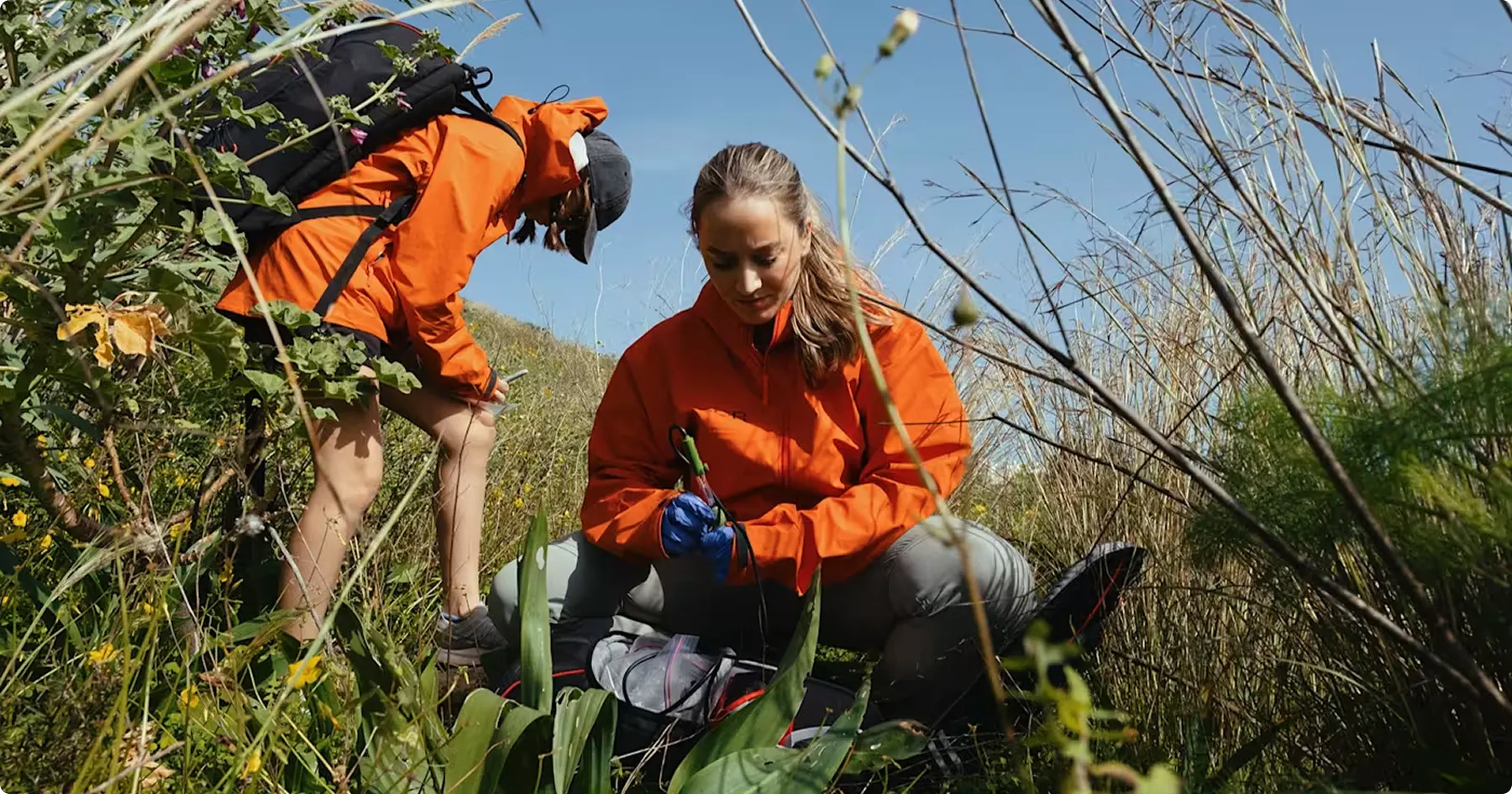
This is the challenge we take on at Basecamp. We have built a global data supply chain that makes scale possible: physical, continuous, partnership driven exploration reaching every corner of planet Earth.
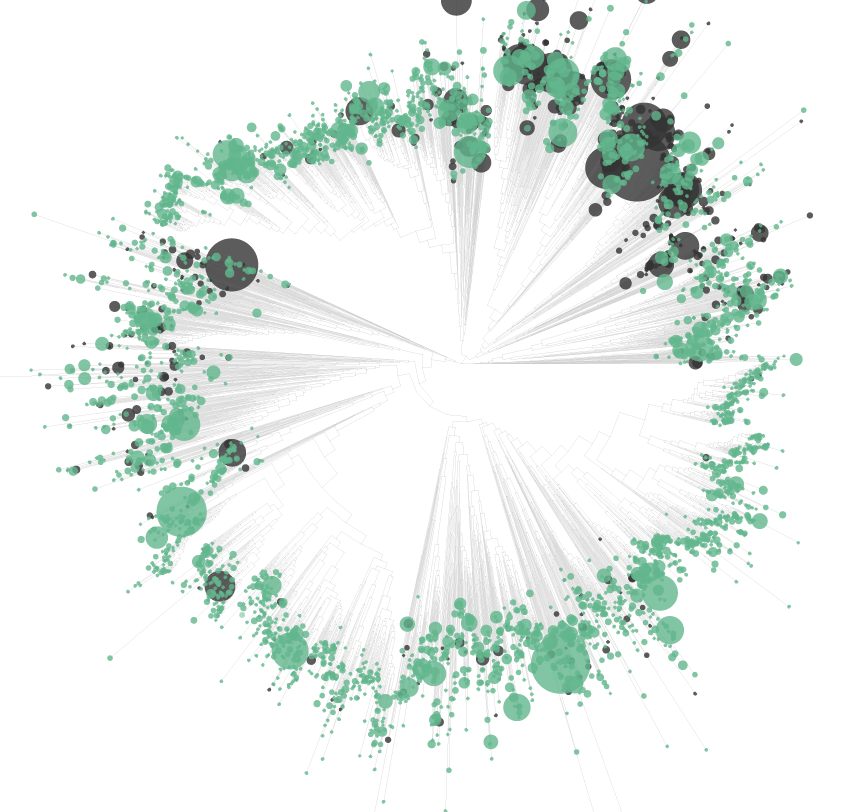
The resulting dataset, BaseData, is a new foundational dataset for biology. Today it holds over 10 billion genes from more than 1 million species new to science, more than a trillion proprietary nucleotide tokens, assembled from more than 30 countries across six continents. It is the largest, most diverse dataset of its kind, and, to our knowledge, the only one ever built with consent agreements tied to every token.
Scale alone is not the whole story. In BaseData, each sequence comes with the genomic and ecological neighbourhood it evolved in, captured at a signal to noise ratio that lets a model learn how biology actually works, rather than how it looks in isolation.
That belief underpins our next step: scaling BaseData by another 100x to the Trillion Gene Atlas, a landmark initiative to assemble over a quadrillion tokens of DNA — making it one of the largest AI training datasets ever assembled, in any field — and model the genomes of more than 100 million new species. Built with Anthropic, Ultima Genomics, and PacBio on NVIDIA infrastructure, it is the data foundation the Bitter Lesson calls for.
2. Computation > EDEN: Where disease prompts the cure
With BaseData beginning to close biology's information gap, we set out to test a simple but radical idea. Could a single model, trained only on evolutionary data and never on a human cell, a clinical record or any task specific label, learn the rules of biology well enough to design real therapeutics on demand, in response to disease biology alone?
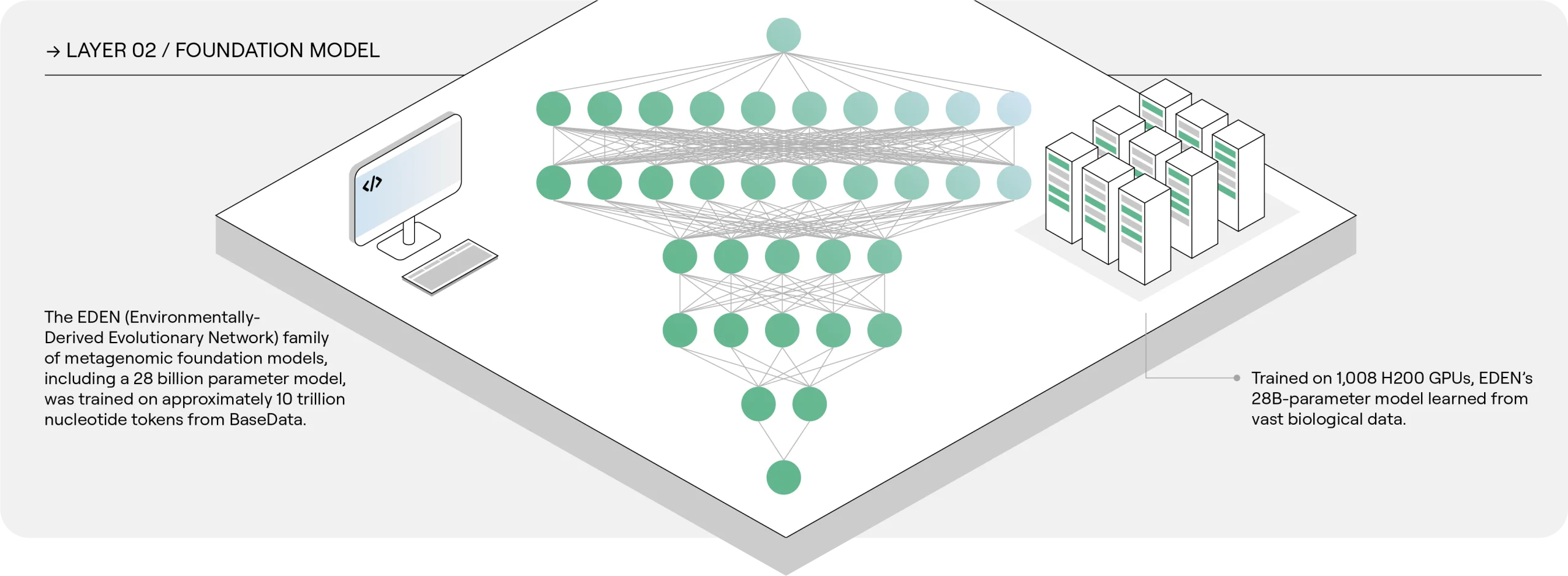
In January, in collaboration with NVIDIA, Microsoft and other leading labs, we published the first EDEN model: a metagenomic foundation model with 28 billion parameters. From that one architecture, EDEN already designs across modalities that have almost nothing in common, at scales spanning a single binding site to an entire microbial community: programmable gene insertion, antimicrobial peptides active against priority pathogens, and synthetic microbiomes at gigabase scale. Each of those came from the same model, not a fleet of specialised ones. A general model trained on enough of biology can beat the purpose built specialist at its own task, the way a general language model came to write better than systems hand built for a single kind of text.
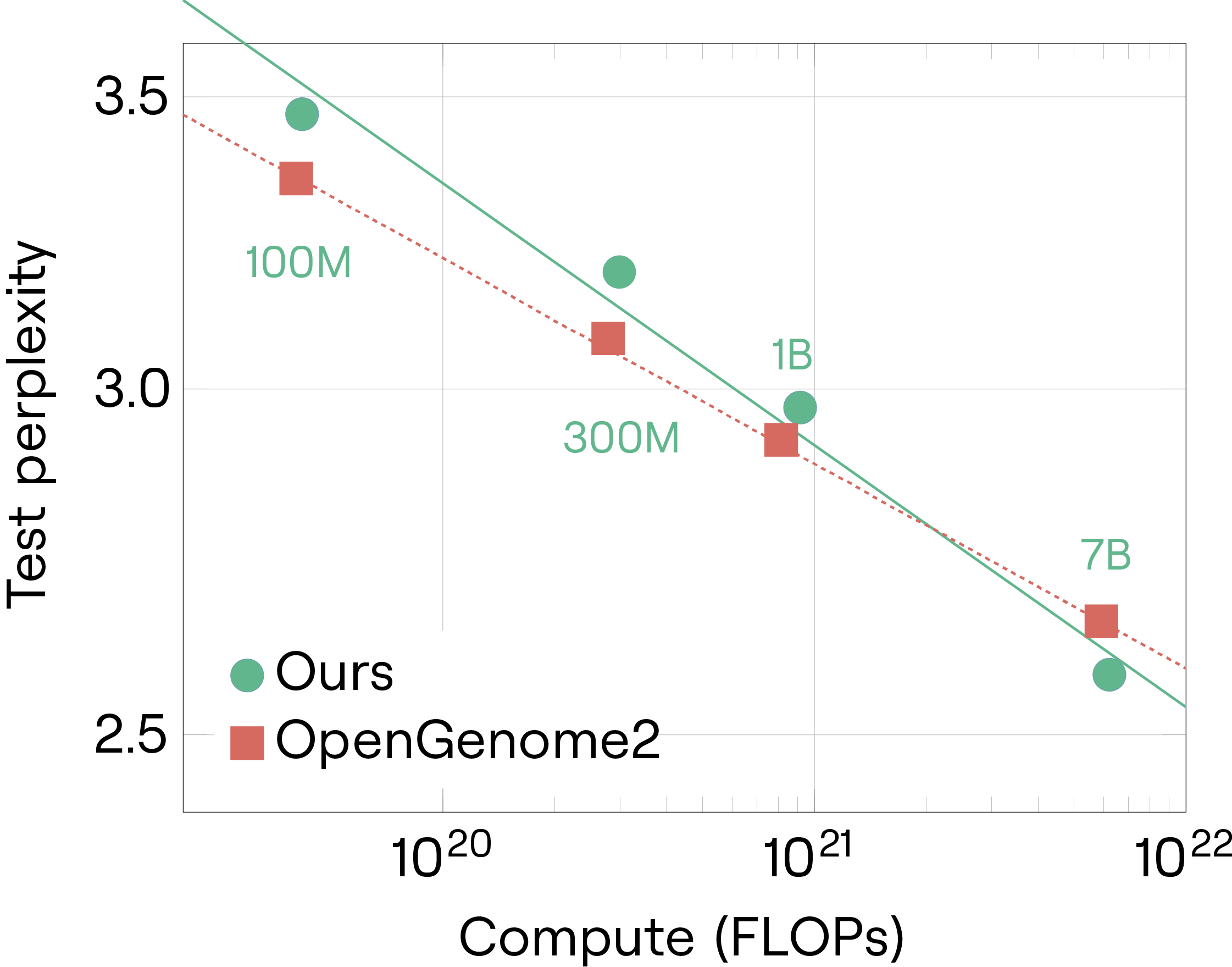
That generality was bought through scale, of both information and compute. Using NVIDIA BioNeMo, NVIDIA MegatronLM, and NVIDIA accelerated computing infrastructure, we trained EDEN on one of the largest collections of evolutionary genomic data ever assembled, and we found that scaling laws govern biological models the way they govern language models. In 2020, OpenAI and others showed that model performance follows predictable power law scaling in parameters, data and compute. The same holds in biology: across orders of magnitude in scale, EDEN's loss falls as a clean power law in compute, and the 28 billion parameter run lands within a few percent of the extrapolation from far smaller models.
The antimicrobial work, aimed at antibiotic resistance, shows what that means in practice. EDEN designed peptides against pathogens on the WHO priority list, the multidrug resistant organisms running out of treatments. In our work with Cesar de la Fuente-Nunez at the University of Pennsylvania, 97% showed micromolar activity in vitro, and the majority of those cleared human cytotoxicity testing. A lead candidate then matched a last line antibiotic in a mouse model, with no optimisation, structure prediction or binding experiments along the way.
EDEN designed it, we tested it, and it performed in a living animal at the level of a drug of last resort. Drug discovery has always meant iterative screening, which scales linearly against a disease biology that scales combinatorially. Here, a model trained on evolutionary genomic data produced a candidate that worked directly in vivo. That is the line between a promising screen and a real path to the clinic.
3. Communication: Putting the model in the room
Information and computation give you a model that has learned biology. They do not, on their own, give a researcher, a clinician, or ultimately a patient, a simple way to use it. A model that can design a recombinase from a 30 base pair prompt, or dial in a peptide against a resistant isolate, is only as useful as someone's ability to put the right question to it, read what comes back, and decide the next step. For most of biology's history, that translation layer has been a researcher writing bespoke code for one model at a time. The agentic era is removing that bottleneck.
This is where our work meets NVIDIA’s vision for agentic life sciences. As datasets keep growing and biological models and scientific agents keep improving, the leap from a patient-specific question to an effective therapeutic candidate stops feeling like science fiction.
The wet lab still matters, though its role is shifting. It is becoming the place where we validate what the model designed, not the place where we discover by brute force. You cannot pipette your way to a general understanding of biology. You can, and must, confirm in the lab what a model trained on four billion years of evolution proposes.
The three parts compound
The Bitter Lesson was, in the end, a lesson in humility: the admission that the world is more complex than our theories of it, and that progress comes from confronting that complexity rather than compressing it away. At Basecamp, we approach Mother Nature with the same humility. We do not presume to know the rules of life. We do the hard work of uncovering them, sequencing the unsequenced, sampling the unsampled, reading four billion years of evolution as the most sophisticated body of design the world has ever produced. We believe that if we listen closely enough, biology will teach us how to design medicine.
We have yet to find the limits, and we do not know whether a trillion genes will be enough for everything we have set our sights on. What we do know is that every time we have increased the evolutionary information available to these models, they have become more capable. The answer is not any one of these parts alone but their combination: BaseData for the information, EDEN to compute over it, and frontier agentic capabilities to put these models in the hands of all.
We believe that this is the path to medicines that are designed rather than discovered: programmable enough to target a specific disease mechanism, personalised enough to fit a specific patient, and curative rather than merely managing symptoms for life. The mice that responded to an EDEN designed peptide is one early step on that path.
Partner with us,
from asset to platform
Take a single EDEN-designed candidate forward into your own pipeline, co-develop around a target or indication, or access EDEN's full design capability across modalities in a multi-program collaboration.
Get in touch